Friday, November 25, 2011
Chuck Miller in OBMag #5
Look for three new poems by Chuck Miller in the upcoming issue of OBSOLETE!

Monday, November 14, 2011
Deadline Extended!
 Because of the number of folks who have contacted me with last minute story and artwork ideas, I'm extending the Deadline for OBSOLETE! #5 to Saturday, December 3rd. Get those pieces sent in ASAP!!
Sunday, November 13, 2011
Looking for "Occupy" scene reports for ObMag #5
Hey folks- can you send me a paragraph or two about your local "Occupy" scene for the next issue? It doesn't need to be slick or polished, just something that captures the local flavor. Photos, flyers or other stuff we can reprint are also welcome.

By Post:
Rich Dana
OBSOLETE Magazine
POB 72
Victor, IA
52347

Please submit work digitally to:
obmag@feral-tech.comBy Post:
Rich Dana
OBSOLETE Magazine
POB 72
Victor, IA
52347
The End Is Near! Submission deadline for ObMag #5 is Tuesday.
We have had more submissions than ever before for the upcoming issue, and some great stuff! It looks like we will be putting out a blockbuster issue- and it's not too late for you to be a part of it!
 Did I mention that we PAY? OBSOLETE pays $1 per line for poems or $5 per 350 words of prose (minimum payment for either genre is $20, maximum $100). Artwork. photos and comics will be paid on an individual basis, ranging from $10-$100. We ask for first North American serial rights only. Copyright reverts to the author upon publication. This applies to original, unpublished work- if you would like to submit previously published work, we are happy to trade for ad space.
November 15th is the deadline for submissions for the next issue of OBSOLETE!
Would you like to see your short fiction, poetry, essays, illustrations cartoons or photos in real, honest-to-god PRINT? Get off your lazy artist ass and send your work to obmag@feral-tech.com . Short stories and articles should be less than 3000 words. Full page comics and illustrations should be formatted to an 11 X 17 page (smaller works welcome).
 Did I mention that we PAY? OBSOLETE pays $1 per line for poems or $5 per 350 words of prose (minimum payment for either genre is $20, maximum $100). Artwork. photos and comics will be paid on an individual basis, ranging from $10-$100. We ask for first North American serial rights only. Copyright reverts to the author upon publication. This applies to original, unpublished work- if you would like to submit previously published work, we are happy to trade for ad space.
Want to Submit by mail?
Rich Dana
OBSOLETE Magazine
POB 72
Victor, IA
52347
Please send a self-addressed stamped envelope (SASE) with your work if you would like it returned. Do not send your only copy! Please do not send original artwork.
The Hall Mall: History of a Counterculture Institution
I just ran across this article while searching through my archives- I wrote it five years ago while we still had our shop, "Feral" in the Hall Mall in Iowa City. Since then, the Hall Mall occupancy has once again dwindled. Still, it remains "The Upstairs Underground", and hopefully will serve as testing grounds for alternative entrepreneurs for years to come.
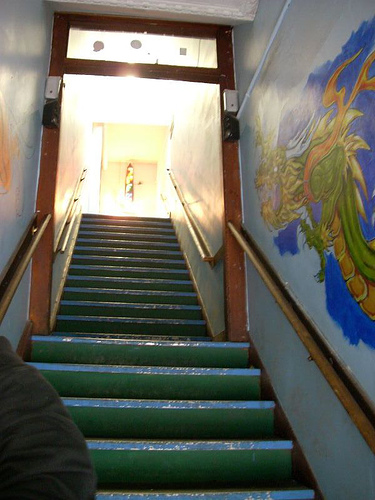
Like many people who grew up in the area, I first encountered much of what is referred to as "Counterculture” in Iowa City. Since the 1960's, Iowa City has had the dubious distinction of being the center of Counterculture in Iowa and it has been home to countless bars, galleries, bookshops, record stores, boutiques and music venues catering to tastes outside of the mainstream. Those of us who have spent some time in this town occasionally grow nostalgic for favorite spots long gone.
I was imprinted early - I spent a lot of time as a child playing between the aisles of Epstein's Bookstore while my parents attended poetry readings. Even at the age of nine, I felt very much at home among the beats and the hippies. In my teens and early 20's, hardcore punk was my thing, and the Unitarian Church basement was the center of our DIY scene. Still, as times changed and scenes have come and gone, certain institutions have survived.
Gabe'n'Walkers/Gabe's Oasis/Gabe's/The Picador is one such institution - despite its recent change in ownership and the removal of the G-word, The bar at 330 Washington remains the most consistent venue for local and up-and-coming bands.
The New Pioneer Coop is another – although many of their original hippy base have turned in their VW beetles for Volvo station wagons and now shop for aged balsamic vinegar rather than mung bean sprouts, it is still the town’s only retail food coop, and has employed countless artists, musicians and slackers since its inception in the early seventies.
Along with these institutions and a handful of others, another, less illustrious cornerstone of Iowa City’s alternative scene has survived since the early seventies. Less of a cornerstone, perhaps, than a cinderblock rammed under the axle of a rusting 69 microbus, The Hall Mall has remained the reliable source for all things counterculture since the days when Jim Morrison walked the earth. Dubbed "The Upstairs Underground" by tattoo artist and Hall Mall veteran Stingray, it has been home to countless vintage shops, record stores, smoke shops and tattoo parlors, providing Iowa City with its own microscopic version of London's Kensington Market or New York's St. Mark's Place.
Like the universe, the Hall Mall is in a constant state of chaos. Businesses come and go, but the vibe remains the same. The merchants maintain an "anything goes" feel and a cooperative attitude that warms the hearts of libertarians and anarcho-socialists alike. "The rent is cheap and the attitude is loose," according to Bil at Focus Body Piercing. "It's the kind of place that, if you are thinking about starting a business, you can go for it. We have built-in foot traffic and the people up here support each other."
Over the years it has been home to businesses with names like The Wicca Shop, Underground Stereo, The Plainswoman Bookstore, Hemp Cat, Good Times, Ruby Tuesday, and Electric Head. The current residents include Exile Tattoo, Focus Body Piercing, The Konnexion, Antiques and Oddities, Rusty Records, FERAL!, the recently opened Convenience Store and Velocipede InfoShop, and the soon to open White Rabbit.
Located above the ped mall at 114 1/2 East College Street, the entrance to the Hall Mall is an inconspicuous doorway sandwiched between College Street Billiards and Vito's. The narrow, poorly lit stairwell leads upstairs to a long, open vestibule, flanked by a series of identically transomed doorways, framed in dark wood popular at the time of the building’s construction at the turn of the last century. Reminiscent of a seedy office building where Sam Spade or Philip Marlowe might have hung out their shingles, one can imagine these offices once housing green-visored bookkeepers or dark-eyed palmists. Something about the location and the modest size has made it the lair of independent small businesses for over a century.
The building which houses the Hall Mall was known in days past as the Schneider Building, originally the home of Schneider Brothers Furniture, Carpet and Rugs. City records show that in 1916, the Schneider Brothers empire had grown to encompass three buildings on the block, and in addition to the furniture business, the building at 114 was listed as "furniture and undertaker."
During the 1920's, the upstairs began to be listed as a separate address, 114 1/2, "The Schneider Building Offices." In the following decades, the offices housed a beauty shop, a number of lawyers, real estate brokers, lenders, "Morford the Chain Man", a publisher, and by the sixties, it was home to the Johnson County Democrats, Alcoholics Anonymous, and L.L. Pelling, now one of the biggest paving companies in the Midwest.
In the early seventies, when downtown business districts across the nation began their decline, many of the spaces at 114 1/2 went empty. It was not long before a new breed of hippie entrepreneurs, including Gregory J. Stokesberry, discovered them. Also known as "The Wizzard" (a moniker bestowed upon him by the late great artist Ed "Big Daddy" Roth), Stokesberry moved in to four adjoining spaces formerly occupied by L.L. Pelling in 1975. Along with Red Rose Old Clothes and Emerald City, "Gregory J. Stokesberry - Organic Merchant" was one of the original pioneers of the counterculture business revolution that would become the Hall Mall.
I recently visited "Wizzard World Headquarters" in Cedar Rapids Czech Village, where Stokesberry runs his current business, marketing original artwork and t-shirts and publishing a magazine, all targeted at the "Kustom Kulture" audience.
"The Hall Mall was the only place in town where a start up could find some cheap space," says Stokesberry. "I got married and had to make a living. I was into antiques, I was in to green plants, all the hippie decor stuff, ya know, and I was in to the birds and monkeys (editors note: exotic animals, not the bands) so that's what I did. I was a hail and hearty lad with a pickup truck - I used to move jukeboxes up and down those stairs."
"The first were Rose (Red Rose Old Clothes) and Kirk at Emerald City - I moved in after them. We all tried to make it nice ... I used to go out and get a bottle of sherry and cookies from Barbara's Bakery. Every afternoon we would have cookies and sherry ... it was always real cool. Eventually the bums started coming up and grabbing handfuls of cookies...the unemployed bums, I mean, as opposed to us employed bums."
The Wizzard was kind enough to take me to his storage space where we discovered a drowsy raccoon sleeping in front of the original sign that once hung outside his store. It is a hand-carved piece by Bill Schnute, the master woodcarver whose work was a hallmark of Iowa City hippie style.
Several of those original businesses survived and thrived, becoming essential parts of the downtown scene, catering to the tastes of those who couldn't find what they wanted in the sterility of the growing mall culture. Throughout the 80's and 90's, the Hall Mall housed a continuous flow of alternative businesses. "This was the place to be - I had heard of this place in Chicago. I moved out here when my girlfriend came to go to college, and I started tattooing up here in '95. At the height of the grunge era, it was always full of people," says Stingray at Exile Tattoo.
It was the 90's - the economy was strong and business was good, and a second generation of Hall Mall regulars was coming of age with their own taste for the bizarre...but times were about to change. Corporate America was waking up to the potential for profit in the underground scene, and set out to create a safe, mall friendly version to sell to the masses. By the end of the 90's, the political climate in America was changing as well. The election of George W. Bush in 2000 heralded the beginning of an era of new conservatism and intolerance, and places like the Hall Mall were bound to experience the fallout.
Hemp Cat, a hemp clothing store and one of the Hall Mall's most popular businesses, was raided in 2001 by the “The Man” and although no charges were filed, their computers were confiscated and they were forced out of business. Several other long-time mainstays left. Stingray and several others left, and Electric Head went into decline. There was a fire. The Hall Mall hit hard times. People began asking "is there anybody up there anymore?" It was down, but not out.
A new generation began to take up residence. The Konnexion, Davey Jones Tattoo, the Lowbrow Cafe and Rusty Records opened, and they were working hard to bring the Hall Mall back to life.
In 2004, with the independent spirit, youthful zeal and naiveté which is a hallmark of Hall Mall tenants, Kelly Stucker bought an existing Hall Mall smoke shop, “Shasta Mountain,” reopening under the name "The Konnexion." “I just kinda jumped in with both feet and hoped to hell it would work out.”
“I used to hang out at the Hall Mall when I was about fifteen – I remember flirting with the cute guy at Moon Mystique. Twelve years later, I have my shop in that same spot…it felt really freakin’ awesome when I got my key to the front door and the old Moon Mystique. It was just fate…”
In October of 2004, my wife Ericka and I were pedaling my paintings and custom bikes and her jewelry at the "Inktober" Tattoo Expo when we met Kelly and Davey. They convinced us that the Hall Mall was coming back, and we should consider renting a space. We opened FERAL! on a shoestring, just before Christmas, selling vintage oddities, lowrider bikes and outsider art and homemade organic catnip toys. It seemed, somehow, like a good fit.
"The Hall Mall revival is underway," according to Brad Allison of Antiques and Oddities, one of the most recent residents. "Back in the day, there was a waiting list to get a space here. 20 years later, there is space available, and I jumped at the chance."
As with all things, the cycle is coming back around, and the "Schneider Building Offices" are being reinvented once again. The Hall Mall has become a music venue, featuring some of the best young acts in the area and offering the only space in town available to the experimental and unabashedly weird. Plans are underway to give the hallway a new look, and to do a mural project in the stairwell. Before long, we hope to have a film festival. Free wireless and comfy sofas provide one of the few smoker-friendly places to study and hang out. As it has always been, the potential of the space is limited only by the resourcefulness of its occupants.
As I grow older and more cynical, I remain optimistic about the Hall Mall. As I watch the increasing corporatization of our society, it seems more and more essential to maintain an outpost whose only mission is to buck the system. If counterculture can truly have a tradition, it is ours to uphold. Like Marlon Brando in "The Young Ones," when asked, "Hey Johnny, What are you rebelling against?" the Hall Mall answers, "What have you got?"
Sunday, October 2, 2011
OBSOLETE #5 - Call for Submissions!!
November 15th is the deadline for submissions for the next issue of OBSOLETE!
Would you like to see your short fiction, poetry, essays, illustrations cartoons or photos in real, honest-to-god PRINT? Get off your lazy artist ass and send your work to obmag@feral-tech.com . Short stories and articles should be less than 3000 words. Full page comics and illustrations should be formatted to an 11 X 17 page (smaller works welcome).
Did I mention that we PAY? OBSOLETE pays $1 per line for poems or $5 per 350 words of prose (minimum payment for either genre is $20, maximum $100). Artwork. photos and comics will be paid on an individual basis, ranging from $10-$100. We ask for first North American serial rights only. Copyright reverts to the author upon publication. This applies to original, unpublished work- if you would like to submit previously published work, we are happy to trade for ad space.Want to Submit by mail?
Rich Dana
OBSOLETE Magazine
POB 72
Victor, IA
52347
Please send a self-addressed stamped envelope (SASE) with your work if you would like it returned. Do not send your only copy! Please do not send original artwork.
Sunday, September 18, 2011
What’s going to become of libraries?
by Christopher Schipper
 A bright young Canadian woman asked me this question recently, as we waited, sheltered from an afternoon downpour, for a streetcar to return us downtown from the New Orleans Museum of Art. The subtext to her question was unmistakable: the eventual demise of libraries, in her mind, was a foregone conclusion. Such questions, sad to say, are neither unique, nor surprising. Reasons for such assumptions are obvious: the rise of the internet has made libraries, in the minds of many, superfluous. Financial support for institutions of education and culture has been in sharp decline for years; a recessionary economy makes the future of libraries perilous.
If the future of libraries is uncertain, the fate of the great city of New Orleans was even less certain not so long ago. I was in town recently for the American Library Association’s annual conference, as I had been five years before. Ten short months after the disastrous hurricanes Katrina and Rita, and the devastating flooding of the city, ALA opted to go ahead with plans for the annual conference. Flood debris still littered much of the city, high water marks were clearly visible, and many storefronts were empty. The people of New Orleans were warm and gracious, but the city seemed a shell of her former self. With a diminished population – and tax base, the future of New Orleans seemed pretty shaky.
When I read predictions of doom for libraries, I am now reminded of remarks I heard at the more recent ALA conference, most notably from the current mayor of New Orleans. I learned that, in the aftermath of the storm, governmental officials made a crucial realization: that libraries are an essential community component; in the days and weeks following Katrina, residents flocked to their libraries, to obtain information, and to communicate with loved ones. Conference attendees were delighted to hear that, with this in mind, New Orleans will have added twenty libraries by the end of 2011. In doing so, New Orleans has made an important investment in its future (this is no small accomplishment in the current ‘cut my taxes’ political environment).
It was not until the main collection of the Cedar Rapids Public Library (where I worked for 13 years) went underwater that, through the tireless efforts of my former colleagues, the federal government (FEMA) finally declared libraries to be an essential service. It’s important at this point to also note that, while the CRPL print collection was destroyed, that library endures.
Let’s consider for a moment what we mean by: library. These days, whether or not the word library represents a physical place is an open question for debate. Many of us have fond childhood memories of visiting the local library – often a Carnegie Library, themselves architectural monuments to Knowledge. Carnegie libraries were long the centerpiece of hundreds of small towns and cities; classically designed, and laden with books for community use and enrichment (libraries, incidentally, represent another American institution that is nearly extinct: the shared public space). Libraries, however, have never been only about books. Besides the Internet, technology has created what many regard as the greatest threat to the printed word and to libraries: the e-book. Indeed, I have many well-intentioned, passionate lovers and defenders of libraries, who regard the relationship between these formats as a competition – in other words, a zero sum game. Concerns that technology will replace beloved print editions are not without basis – a number of libraries have done exactly that, but for a number of reasons, I can’t see that happening everywhere any time soon. Time magazine recently published an article (“Is a Bookless Library Still a Library?”) that considers this question. Personally, I think a library without books would be a contradiction in terms, but this a possibility. Information is now available in more formats than ever before; people use different formats because of different needs. Libraries are about much more than just the books they house – they’ve always been about connecting people with the information that they want or need; officials in New Orleans understand this, and the future of libraries in that great city, for now, is bright.
I’m the director of the campus library at San Juan College – a two-year school located in Farmington – in a remote and rural part of Northwest New Mexico. Farmington is often referred to as a border town, because of its proximity to the Navajo Nation. Our geographic location contributes to a very significant digital divide (the chasm between those who have access to the internet and those who do not), making any predictions for the obsolescence of print wildly premature. While we have e-books available for use, our print collection is still heavily used – in part because some of our users lack what many of us take for granted: home internet access, a personal computer, and in some cases – electricity. If not for the library, many library users would lack access to not only the internet, but information that is essential to their lives. In today’s political climate, perhaps the very egalitarian nature of libraries motivates some of the questions related to the value of libraries. While uncertainty about the viability and future of libraries (and despite the rise of the internet) persists, their continued use is not at all in question:
Library use continues to climb. Sixty-eight percent of adults in the U.S. have public library cards, the greatest number since the ALA began collecting this data in 1990.
Americans visit libraries more than 1.3 billion times and check out more than 2.1 billion items each year. Users turn to their libraries for free books, to borrow DVDs, to learn new computer skills, to conduct job searches and more.
Americans go to school, public and academic libraries 50 percent more often than they go to the movies.
A 2006 poll conducted by the American Library Association found that 92 percent of respondents expect libraries to be needed in the future, despite the increased availability of information on the Internet.
Nationally, the average user takes out more than seven books a year . . . but users turn to their libraries for more than books: to borrow DVDs, to learn new computer skills, to conduct job searches, and to participate in the activities of local and community organizations.
Nearly all Americans (96 percent) – even if they are not regular library visitors – agree that libraries play an important role in giving everyone a chance to succeed. They support our public education and lifelong learning.
There are now more public library buildings in the U.S. than there are McDonald’s – a total of 16,592, including branches.
Library use continues to rise – public library visits exceed 1.3 billion, and libraries circulate more items than Fed Ex ships – more than 2.1 billion books, CDs, DVDs and more.
Americans check out on average more than seven books a year. They spend about $31 for the public library – about the cost of one hardcover book.
Americans spend about two-and-a-half times as much on salty snacks as they do on public libraries.
(http://www.ala.org/ala/issuesadvocacy/advocacy/advocacyuniversity/toolkit/talkingpoints/libraryuse.cfm)
As the last bullet point above indicates, financial support for libraries is sadly lacking. In New Mexico, we have a bond initiative to support libraries, but the measure requires voter approval every two years. This “book bond” came into being as a way for the voters to supplement the lack of legislative support for libraries throughout the state. In the run-up to the last bond approval, I was called a dirty Marxist for making the case that libraries in the state are under-funded, and desperately in need of the money that the bond represents! While libraries are hardly a socialist enterprise, the return on investment is impressive, if one considers the bullet point above (average checkouts: 7 books per year).
At San Juan College, we serve a terrifically diverse demographic, with widely varied informational and technological needs and expectations. During my short time here (I began work here in 2006), I’ve noticed a shift from non-traditional students, to a younger demographic; students who have just completed high school, and have never known a time without Internet. With ready access to web-based information, and a lifetime of technology skills, what use do younger, tech-savvy students have for libraries? Can the internet serve as a viable substitute for libraries? If one considers the internet to be a library of sorts, one would also have to concede that it is a very poorly organized library, and one that grows by staggering degree every day; portions of the internet are available only at a cost (e.g. – research databases and other subscriptions). Libraries provide resources that assist students in this regard; access to subscription-based research databases is a common feature at US academic libraries, and professional staff (i.e. – reference librarians) that is skilled in assisting users with the navigation of the internet and other complex information media.
Younger students are oftentimes not traditional readers, and some never have owned a book. Many of our youngest students seem not to recognize the value of print formats; they lack familiarity with standard research strategies such as the use of the subject indexes that are commonly found in the back of books. Any reading that these students do is more commonly from an electronic screen – a reality that today’s library ignores at its peril. Our library must also recognize and support the variety of learning styles that exist among our students. Kindles that utilize a text-to-speech function are invaluable for our developmental or dyslexic students. Our library has five Kindles available to borrow; we have recently purchased three Nooks for circulation as well. We have approximately 70,000 volumes in our print collection, but also about 25,000 e-book titles. My point is that we strive to meet the needs of all of our users, and do so using a successful integration of formats; we offer books, magazines, journals, electronic articles, e-books, Kindles, Nooks - successfully, and without incident. To do otherwise is truly to risk obsolescence, particularly among younger library users. Lacking an adequate array of useful resources, and a well trained staff, a traditional library is little more than a room full of books, in the eyes of our youngest (and future) users – and a dinosaur. Incidentally – we still spend more on print books than just about anything else.
I don’t know what the future of libraries in the US holds. The liquidation of bookstore giant Borders is in the news today. A political solution to the nation’s budget and debt crises is proving elusive. Adequate funding for the nation’s libraries may assume diminished priority over time, but this would be penny wise, but pound foolish; voters are tragically unable or unwilling to recognize the connection between the taxes, and the services such as libraries that many take for granted. Libraries represent an invaluable repository of knowledge, culture and human achievement – and a means for most of our citizens to actualize their own potential. Libraries have always evolved; a decent library is a dynamic thing, but one that cannot afford to stagnate.
Friday, September 9, 2011
9/11, oil and being part of the solution.
Here is a short essay I wrote for the Iowa Renewable Energy Association newsletter shortly after 9/11. I think it's still relevant, unfortunately.

Let us in Iowa and across the nation take this on as our personal responsibility, to make this Americas last battle caused by foreign entanglements rooted in oil, and to honor the lives of those forever entombed in the rubble of corporate greed.

From “Energy Matters”, Fall 2001
by Rich Dana
“By the way, if you want to have a war over oil, leave me out of it- because I don’t think we need it. All I have to say is, go solar! Go wind! Let a little freedom into your life, and help your neighbors stay free, too. FREEDOM!”
Richard Perez, Publisher, Home Power- keynote address at I-Renew Expo, Sept. 8, 2001
I was disassembling the geodesic dome we had erected at Prairiewoods for the expo on September 11 th, 2001. It was a warm and windy late summer day, and the trampled grass in the meadow still held the positive energy of all those curious and excited visitors who had walked there in the previous days. But the radio in my truck flooded the air around me with news of unspeakable acts of desperate and hateful men.
My mind was back in New York, tracing in vivid detail the sights and sounds of my daily bicycle ride across the Brooklyn Bridge, under the shadow of the twin towers, dodging taxis or catching a tow on the back door of a delivery van, to my woodshop just a few blocks north of the Trade Center.
I sat down and looked up through the octagonal and pentagonal sections of the dome, which made the sky and prairie around me like the colored segments of a stained glass window. I feared for my friends and family back in the city, and for the world, and listened with dull, numb disbelief.
In the month that followed, I kept thinking about the words of Richard Perez, during his keynote address just 3 days before the attack. He talked about the freedoms that renewable energy can bring. Among them were economic freedom and freedom from wars over oil. In those months I have read extensively about the roots of the hatred for America in Central Asia and the Middle East, and realized the extent to which motivations for action on both sides of the conflict are determined by the lust for oil.
It is with this knowledge that I invite you all, as members of the renewable energy community, to join me to work with new and greater resolve, to prove to the world that we in Iowa CAN become exporters of homegrown energy, that we CAN significantly reduce our nations dangerous reliance on vulnerable sources of energy like foreign crude, natural gas and nuclear. We know that we can do this by using the great renewable resources we are blessed with here in Iowa, not the least of which is our minds, our hearts, and our spirit.
Subscribe to:
Posts (Atom)